
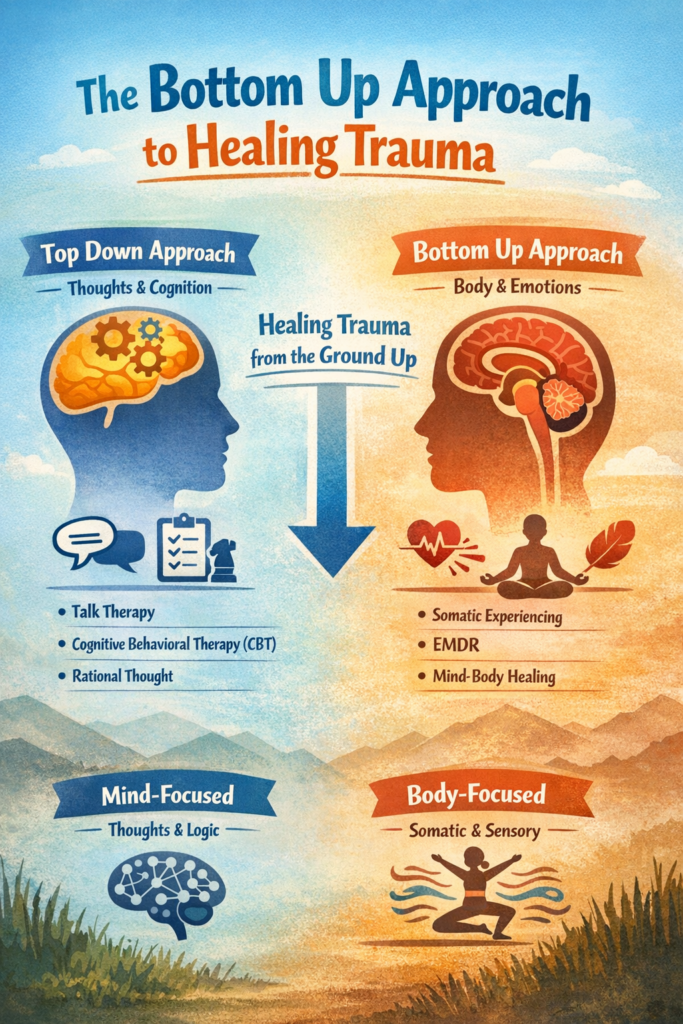
What does a “Top Down” or “Bottom Up” Approach Mean?
Categorizing approaches as top down vs bottom up refers to which area of the brain the approach or modality targets. The front or top part of our brains manages our language, thoughts, feelings, personality, and voluntary movement. It also controls decision making, planning, and impulse control. Top Down approaches target this area of the brain. The base of our brain is the part that manages reflexes, memories, and automatic responses. Accessing this part of the brain is key to working through trauma. Bottom Up approaches target this area of the brain.
What is the Top Down approach?
Think of the Top Down approach as your traditional talk therapy. This approach focuses on your thoughts, beliefs and perceptions, and sometimes your behavior. It targets the rational, problem solving parts of your brain, located in your prefrontal cortex. The Top Down approach aims to treat common mental health challenges by restructuring thoughts, challenging irrational beliefs, and changing negative thought patterns.
Modalities that typically work from top down include:
- Cognitive Behavioral Therapy (CBT),
- Rational Emotive Behavioral Therapy (REBT),
- Psychodynamic Therapy
- Narrative Therapy
- Cognitive Processing Therapy (CPT)
These modalities are helpful to treat mild anxiety, depression, OCD, and negative thoughts. They help to process thoughts and emotions, focusing on providing insight to harmful thought patterns and beliefs. Because trauma affects the part of the brain that doesn’t respond to reason or logic, it is not easily accessed by traditional talk therapy. This approach alone may not be the most helpful when healing trauma.
How is the Bottom Up approach different?
Bottom Up techniques aim to access the limbic system, which is the reactive part of the brain. It is the area of our brain where it is believed that trauma is stored. It doesn’t require you to understand, put words to, or rationalize your thoughts and feelings. It meets you where you are, in the part where trauma is stored and targets the automatic and somatic experiences the body has in response to trauma. This approach even works if you aren’t aware of or able to remember the traumatic experience, because our bodies are able to access it for us when words can’t. Reactions to stress and triggers are involuntary, as it’s our body’s way of trying to protect us. Learning to connect with our bodies and process through our bodies instead of our thoughts and feelings helps us to process without reliving those traumatic experiences.
Modalities that use the bottom up approaches include:
- Eye Movement Desensitization and Reprocessing (EMDR)
- Somatic Experiencing
- Internal Family Systems (IFS)
- Expressive Arts Therapy
- Dialectical Behavior Therapy (DBT)
What mental health challenges can be treated using Bottom Up approaches?
The above techniques can be used to treat many common mental health challenges, and are especially known to help treat trauma. Some of those challenges include:
- Stress
- Anxiety
- Trauma
- PTSD
- Depression
- Nervous System Dysregulation
What is Simply Teens approach?
At Simply Teens Outpatient, we are trauma informed and use a variety of Bottom Up techniques throughout our treatment process. We recognize that our bodies respond to stress and trauma before we can even name what the triggers are, therefore we prioritize connection with the body over verbal processing. Through expressive arts, body scanning, and nervous system regulating, we aim to help teens and tweens connect with their bodies first to heal their minds.